Allegations of silent terminations at edtech startup Physics Wallah (PW) have surfaced over recent months, with multiple former employees seeking to campaign against their terminations. The developments coincide with a critical phase for the company, which recently received approval from the Securities and Exchange Board of India (SEBI) for its Initial Public Offering (IPO), expected to raise approximately ₹3,820 crore.
According to PW’s Draft Red Herring Prospectus (DRHP), the company undertook a restructuring exercise across FY24 and FY25, impacting several faculty members. The faculty attrition rate, which stood at 18% in FY23, rose to 40.4% in FY24 before declining to 26% in FY25.
Some industry analysts explain PW’s policy saying faculty quality is the dominant determinant for a company such as PW to succeed. But disgruntled former employees talk about unfair treatment.
A detailed questionnaire was sent by The Hindu to the managing partners of Physics Wallah seeking their response to the allegations. The company declined to comment.
Disgruntled staff
Those who have been let go have been vocal about their cases. Paras Agrawal, one of around 20 employees reportedly let go in the past three months, said he has yet to receive his experience letter. Mr. Agrawal had worked at PW for three years as a doubt-resolution expert.
“They said they were restructuring the company’s doubt portal, but only a few employees were affected at that time,” he said.
The doubt-solving team, which consists of approximately 100 members, is responsible for addressing academic queries but does not interact directly with students, he said, adding that around ten employees were removed from this team, along with several experienced faculty members.
“An opaque process was followed in the name of performance review. We were never informed about the metrics used to evaluate us, nor did we have review meetings with our managers,” Mr. Agarwal said.
He added that the team was expected to resolve 170 student doubts per month. If some employees fell short of this target, he said, the additional workload was passed on to others, contributing to what he described as a competitive and stressful environment.
PW’s DRHP notes that its AI-driven tool, AI Guru, handled approximately 3.16 million queries per month for JEE and NEET courses in FY25.
Mr. Agrawal and other former employees have taken legal action, with some issuing legal notices citing breach of contract and unfair termination. Emails accessed by The Hindu indicate that legal claims have included allegations that termination violated stipulated notice periods and contractual clauses.
“I filed a complaint in the labour court, and they later settled with me by offering two months’ compensation,” Mr. Agrawal said.
Poonam Rawlani, a former faculty member, alleged that faculty were let go during the academic session while the company continued uploading videos online. This is not the first instance of reported mass layoffs at PW. Around 120 employees were reportedly terminated in 2023.
Abhishek Kartik, who previously taught JEE Mathematics, said, “I was asked to resign without proper reason, and my job was handed to a junior faculty member. There’s a lot of internal politics.”
Some former employees have also raised concerns about staffing practices, alleging that interns or college students were sometimes hired as full-time staff. According to them, these fresh recruits were trained through internal teaching programs and then assigned to centres where more experienced faculty had been showcased during promotional events.
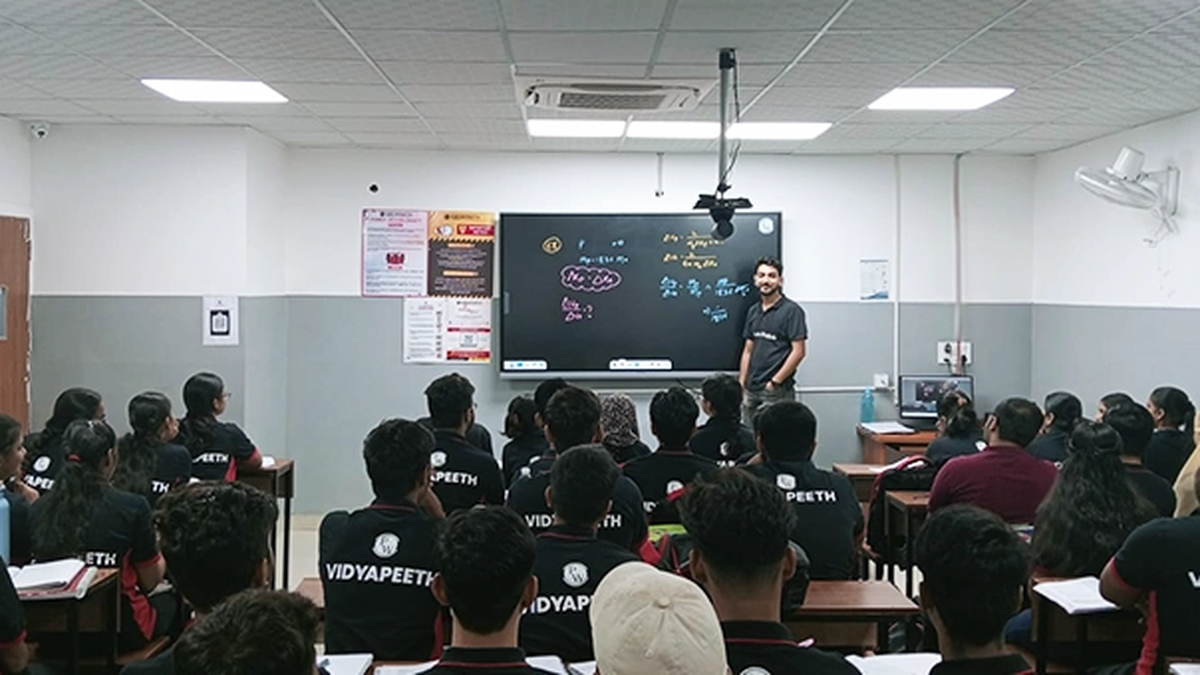
As of March 31, 2025, the company employed 5,096 faculty members, including teachers, content developers, and doubt-resolution experts. The DRHP states that Faculty Training Programs (FTP) are conducted over several months by experienced staff.
Mr. Agrawal also claimed that while staff received pay hikes in FY23, there were none in FY24, citing what the company reportedly described as underperformance. He alleged that the company increasingly hires freshers to cut operational costs.
Growth story
Despite internal challenges, PW has seen significant growth. In FY25, it recorded a 59.19% revenue increase and had a cumulative 4.46 million paid users between 2023 and 2025.
From the student perspective, experiences appear mixed. Isha Tanwar, a Class 11 student at Delhi Public School in Nagpur, said, “I thoroughly enjoyed learning chemistry here. PW opened doors for students who doubted their dreams because of financial limitations.”
Anurag Rawat, a student from Chennai, observed, “We learn from multiple platforms. I used one institute’s biology videos but chose PW for physics.”
In a move aimed at improving transparency, PW has introduced a review system for students to regularly evaluate teachers. Sources claim that students are also allowed to vote to remove a teacher from a programme. The DRHP states that performance evaluations are increasingly data-driven, based on student feedback, adherence to planning schedules, and assessments by subject-matter experts.
However, concerns remain over the experience levels of some faculty at offline centres. “Most teachers deployed at our centre were inexperienced. Many students try to imitate star faculty but don’t get the same quality of instruction,” said Aishwarya Mohanty, an offline student in Noida.
Initially launched as a YouTube channel, PW has built a substantial online presence, operating 207 active channels with a total subscriber base of 98.8 million, growing at a CAGR of 41.8% between FY23 and FY25. Much of this growth, the DRHP notes, was driven by free content provided across digital platforms.
Keshu Verma, a student from Satara, said, “For students like me from villages with limited finances, PW’s online courses are the only option.”
The DRHP also reported a 42% increase in student complaints and queries, rising from 7.4 lakh in March 2024 to 10 lakh in FY25.
PW has gained widespread recognition for offering relatively affordable programs, with fees starting at ₹40,000 — considerably lower than those of many competitors. Since opening its first offline centre in Kota, the company has expanded to 198 centres in 109 cities.
As PW prepares for its IPO, industry analysts note that faculty satisfaction and student retention remain critical for long-term sustainability.