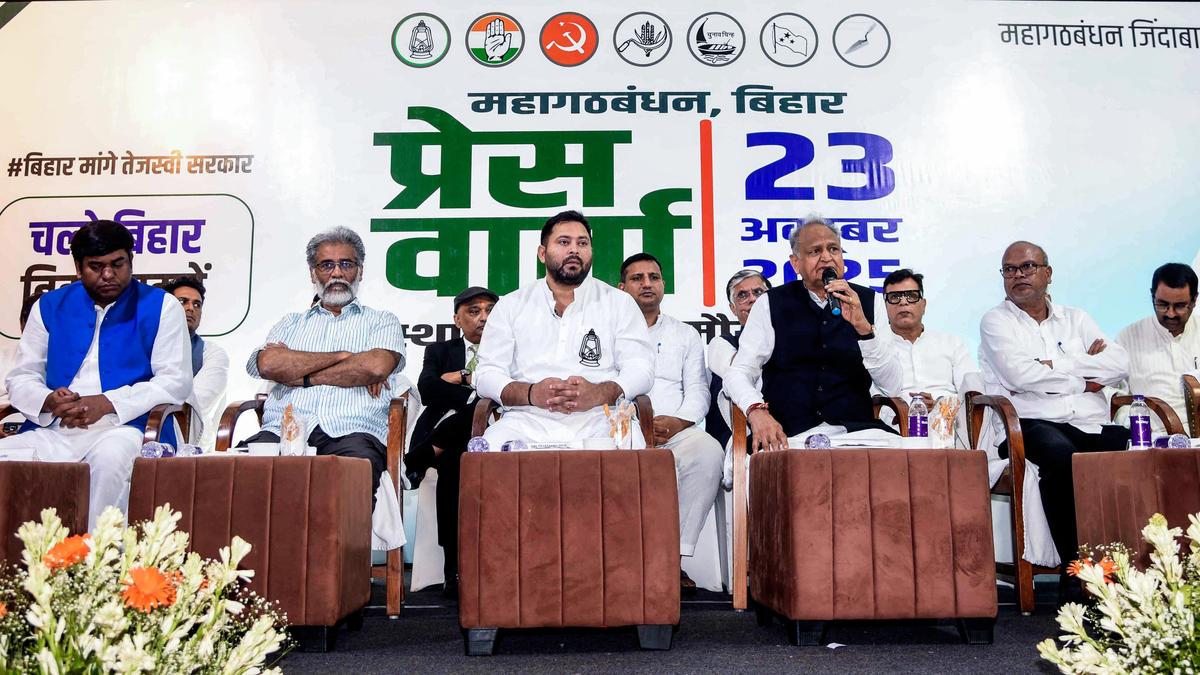
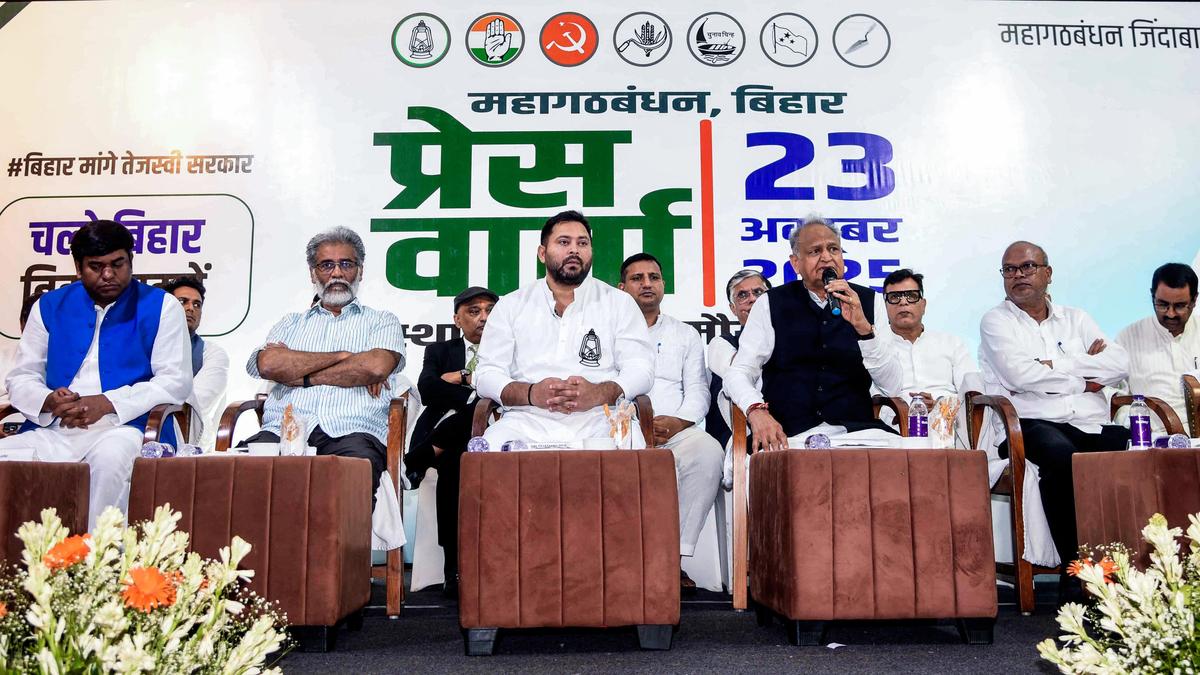
Former Rajasthan Chief Minister, Ashok Gehlot speaks at a press conference with Leader of Opposition in Bihar State Assembly Tejashwi Yadav, RJD Rajya Sabha MP Sanjay Yadav, Vikassheel Insaan Party Chief Mukesh Sahni, Bihar Congress state President, Rajesh Kumar and CPI (ML) National General Secretary, Dipankar Bhattacharya present, in Patna on Thursday, October 23, 2025
| Photo Credit: ANI
Bihar’s political duopoly – the Mahagatbandhan (grand alliance) and the National Democratic Alliance (NDA) – appears to be getting well entrenched, leaving behind a shrinking space for any third or other political formation.
The perceptible shift in the pattern of voters’ preferences can be seen from the 2015 outcome when the grand alliance, consisting of the Rashtriya Janata Dal (RJD), its traditional ally Congress and the Janata Dal (United) (JDU), handed down a drubbing to the Bharatiya Janata Party (BJP)-led NDA. At that time, the combined vote share of the two principal formations exceeded 75%.

The grand alliance’s vote share was 41.84%, with 178 seats out of a total of 243, while the NDA secured about 34% with 58 seats. This election was the only instance of the JD(U) facing the electorate along with the RJD and the Congress. On all other occasions, it was with the BJP, as part of the NDA.

Prior to 2015, the two formations’ collective strength was close to two-thirds of votes polled. It was about 65%, both during October-November 2005 when the NDA decisively ended the 15-year reign of the Rashtriya Janata Dal founder Lalu Prasad, and in 2010 when the NDA won a whopping number of 206 seats. In the first Assembly election (February 2005) that took place after Jharkhand was carved out of Bihar in November 2000, the combined vote share was about 53%.

The strength and appeal of the principal formations are such that those who tried their luck independently could not sustain themselves and ended up joining either of the two coalitions. At the same time, it is not that the formations do not benefit from the presence of smaller parties. A prominent example is the Communist Party of India (Marxist-Leninist) Liberation, which had faced the elections on its own or along with smaller parties up to 2015. Five years ago, it joined the grand alliance, winning 12 of 19 seats it contested.

On different occasions in the last 20 years, the State’s two prominent Dalit leaders — Ram Vilas Paswan, who founded the Lok Janshakti Party (LJP) and his son Chirag Paswan, who is heading the LJP(RV-Ram Vilas) — attempted to make it big independent of the two formations. In the February 2005 poll, the LJP won 29 seats. Even though there were widespread expectations that it would play the kingmaker, the circumstances were such that the Assembly was dissolved by then President A.P.J. Abdul Kalam in May 2005 even before it met once, the first such occurrence in the country. The continued presence of the Hindustani Awam Morcha (Secular) (HAM-S), a breakaway from the JD(U), in the NDA is another illustration of mutual dependence of the players concerned.
The entry of the Jan Suraaj Party (JSP), founded by poll strategist-turned-politician Prashant Kishor, into the fray has triggered a talk about the possibility of the JSP ending the State’s duopoly, just as the Aam Aadmi Party (AAP) and YSR Congress Party (YSRCP) did in Delhi and Andhra Pradesh, respectively. However, with Mr. Kishor opting out of the electoral fray, it remains to be seen whether the JSP will be able to relegate the grand alliance or the NDA to the third spot.
Published – October 23, 2025 09:17 pm IST