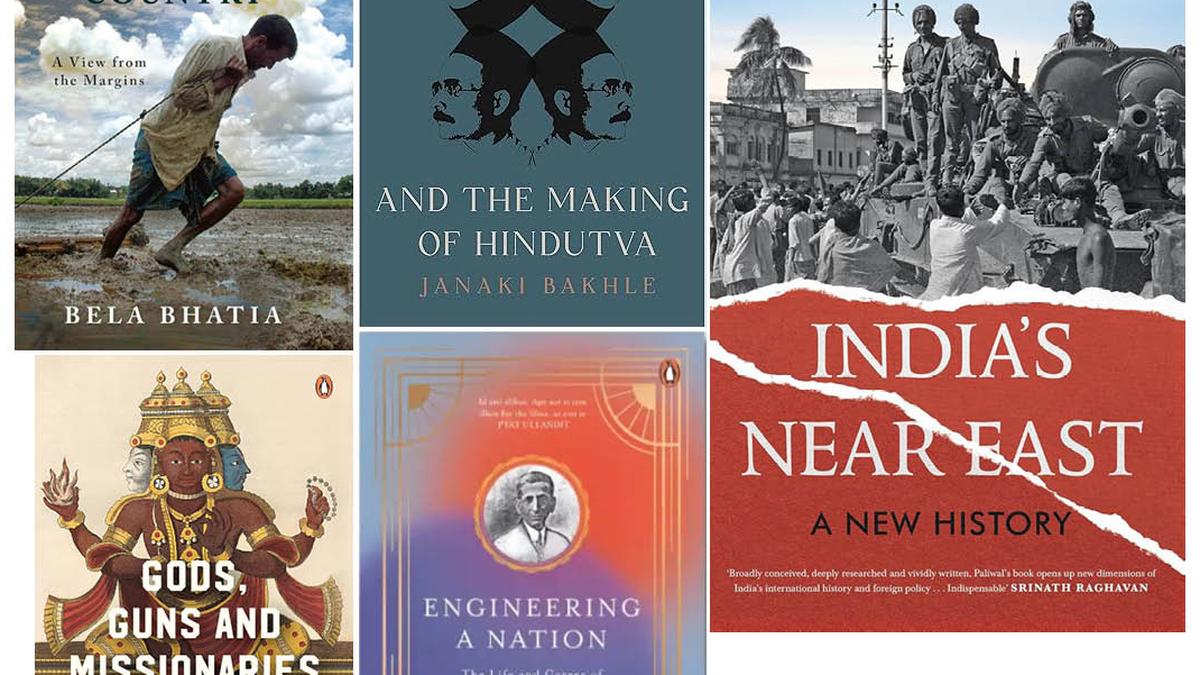
An intellectual history of Hindutva ideologue V.D. Savarkar, essays from fieldwork among India’s marginalised, a book on India’s challenging relations with Myanmar and Bangladesh, an account of how colonialism, Christian missionaries and indigenous reform movements shaped modern Hindu identity, and the life and work of engineer-statesman M. Visvesvaraya have made it to the shortlist of the NIF Kamaladevi Chattopadhyay Book Prize 2025.
The review in The Hindu called Janaki Bakhle’s Savarkar and the Making of Hindutva (Princeton University Press/PRH) one of the most “detailed and dispassionate analysis of the ideals of Savarkar.” She drew on Savarkar’s writings in Marathi and English for her examination of Savarkar’s ideas, which have become the “blueprint for exclusionary Hindu nationalism.”
Bela Bhatia gathers her three decades of work among Dalits, Adivasis, women and other communities in India’s Forgotten Country: A View from the Margins (Penguin).
Avinash Paliwal looks at India’s relations with India’s eastern neighbours in India’s Near East: A New History (Penguin). The review in The Hindu said Paliwal has carefully woven “the histories of India’s northeast with Bangladesh and Myanmar with the regular appearance of China. Narco-crime, long-standing insurgencies, political ambitions and interpersonal rivalry mix with religious nationalisms of different hues.”
Talking about Gods, Guns and Missionaries: The Making of the Modern Hindu Identity (Penguin), historian Manu S. Pillai says the interplay of colonialism, Christian missionary activity and home-grown reform movements “impacted the way we define Hinduism and the Hindu identity today, while also shaping Indian Christianity.”
Aparajith Ramnath’s Engineering a Nation: The Life and Career of M. Visvesvaraya (Penguin) profiles one of post-Independence India’s most well-known engineer-statesman. Mokshagundam Visvesvaraya (1861-1962) “pushed strongly for industrial modernity in a colonial era that could not conceive of the idea of Indian self-reliance.”
Rahul Matthan, member of the governing board of NIF, said for the shortlist of five from a longlist of 10 books, the jury not only looked at the quality of research and originality of perspective but also how each title “deepens our understanding of India’s recent past and present.”
The winner will be announced on December 6.
Published – October 24, 2025 04:42 pm IST