
“Why did I always think that mangroves had something to do with mangoes?” grinned Taran, looking at the mangrove roots growing out above the ground. He was floating down the Ariyankuppam river, near Puducherry, in a fishing boat. It was early evening but the air was still muggy.
“Haha! You thought it was a mango grove! Mangroves grow in coastal swamps and are characterised by those half-arial dense tangled roots. No mangoes here!” smiled Appa.
“Uff, I’m sweating”, said Amma fanning herself with a cap. “Why would anyone want to travel around in this heat?”
“Because where we are headed was quite a coveted place in history. In fact, it is the only place in India where there is a Roman footprint from the first century BCE. Hello
This doesn’t work for Education Plus. was an ancient port that traded in glass beads. Imagine an intaglio of Augustus Caesar was found here,” explained Appa.
“What’s an intaglio? Is it like Aglio Olio pasta?” asked Taran.
“This boy is always thinking of food. It’s not a pasta but an engraved design on a precious stone and was found here by an Indologist from France. That’s when the significance of the place came to light,” said Appa.
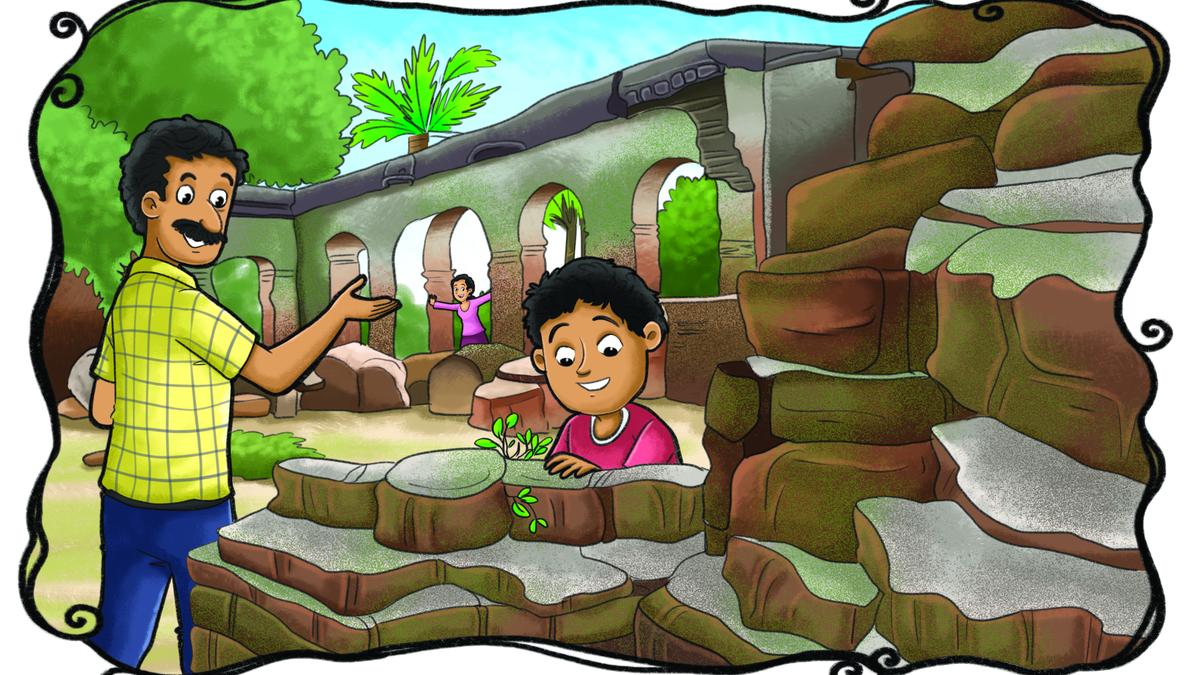
The boatman signalled for them to get off. They wobbled out and walked a short distance to a derelict building. There was a small board that said “ancient archaeological site”.
A walk through the past
“This was built by the French missionaries,” said Appa. They walked around and stopped to look at the foundations and brick stones of an older era. “The port was controlled by the Cholas as well,” said Appa, reading, walking, and looking simultaneously.
Apart from a few more dilapidated buildings with trees sticking out and a few other curious tourists, the place was quiet. There was no indication of the glorious past and the hustle-bustle Arikamedu must have once witnessed.
The family sat down and pulled out the sandwiches they had packed from a café in Puducherry. “Some interesting things have been excavated by archaeologists at this site, such as amphorae (or ancient Roman jugs), glassware, gems, coins and beads. They are not to be considered baubles but to be looked at from a historical perspective,” read Amma.
Taran chopped on his sandwich. “This place looks ‘mid’, but was not mid in any way. It was actually lit! It is a place where Romans and Indians connected!”
“Oh no! Not Gen-z lingo!” said Appa, feigning shock.
“Look, Appa, if the Romans, from a faraway land, came to this little port in India and figured out how to communicate, you can do the same with Gen-Z,” teased Taran.
“Good point, Taran,” said Appa. “This place is not ‘mid’; its super-duper lit.”
Published – October 24, 2025 03:05 pm IST