
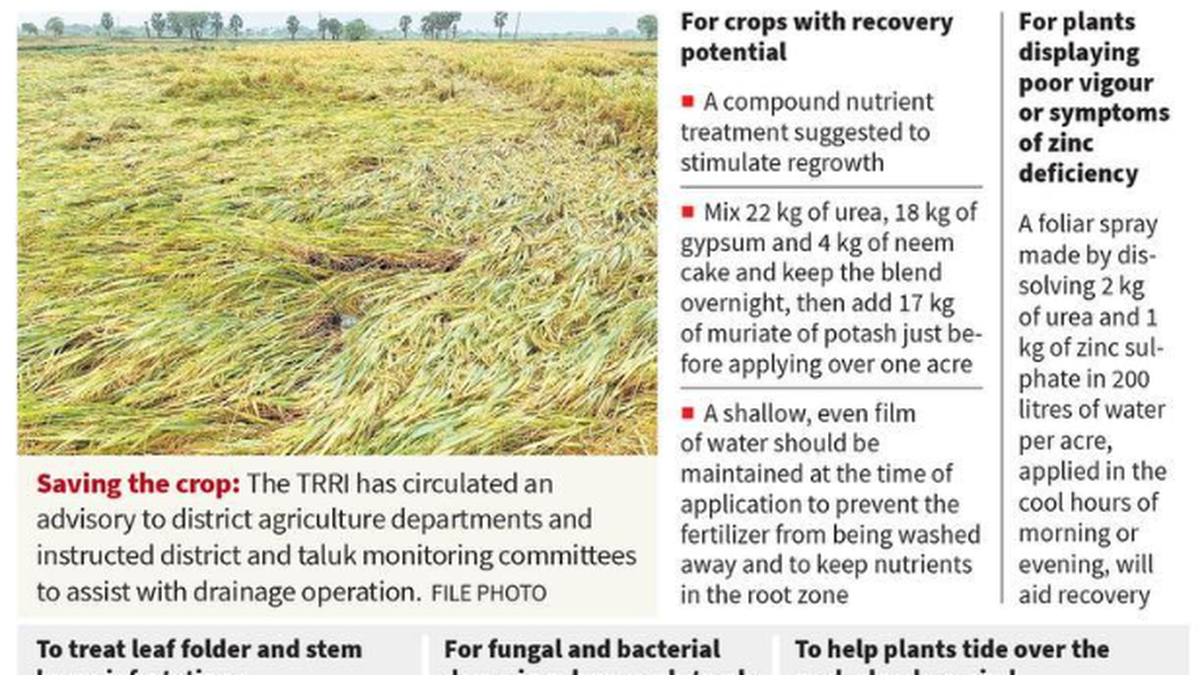
Recent Northeast monsoon rains have left vast stretches of the Cauvery Delta under water, putting samba and thaladi rice crops at immediate risk and prompting the State-owned rice research establishment to issue a hands-on rescue plan for affected farmers.
Speaking to The Hindu, K. Subrahmaniyan, Director of the Tamil Nadu Rice Research Institute (TRRI), laid out a practical, step-by-step field programme to salvage standing crops and limit yield losses. He advised that excess water be drained without delay and that completely damaged patches be gap-filled with seedlings of the same variety where possible. After drainage, soil aeration should be restored with a cono-weeder or rotary weeder so root systems can recover and resume nutrient uptake.
For crops that show recovery potential, Mr. Subrahmaniyan recommended a compound nutrient treatment to stimulate regrowth: mix 22 kg of urea, 18 kg of gypsum and 4 kg of neem cake and keep the blend overnight, then add 17 kg of muriate of potash just before applying over one acre. He emphasised that a shallow, even film of water be maintained at the time of application to prevent the fertilizer from being washed away and to keep nutrients in the root zone.
Where plants display poor vigour or symptoms of zinc deficiency, a foliar spray made by dissolving 2 kg of urea and 1 kg of zinc sulphate in 200 litres of water per acre, applied in the cool hours of morning or evening, will aid recovery. Dr. Subrahmaniyan warned that wet conditions favour leaf folder and stem borer infestations and advised the use of Chlorantraniliprole 0.4% at 4 kg per acre or Cartap hydrochloride 4% at 6 kg per acre, strictly according to label directions. To check fungal and bacterial decay in submerged stands, he suggested a prophylactic foliar spray of Carbendazim, 200 g in 200 litres of water per acre, applied with a hand sprayer.
Noting that reduced sunlight and low soil temperatures at this stage can limit nutrient uptake, the TRRI director recommended a short foliar nutrient boost — 2 kg (urea or DAP or muriate of potash) dissolved in 200 litres of water per acre — to help plants tide over the cool, cloudy period.
Mr. Subrahmaniyan urged farmers and extension officers to follow label instructions for all agrochemicals and to use appropriate personal protective equipment during mixing and spraying. The TRRI has circulated the advisory to district agriculture departments and instructed district and taluk monitoring committees to assist with drainage operations, supervise correct preparation, and application of the fertilizer mixes, and keep farmers informed through mass and social media channels.
Published – October 25, 2025 09:49 pm IST