
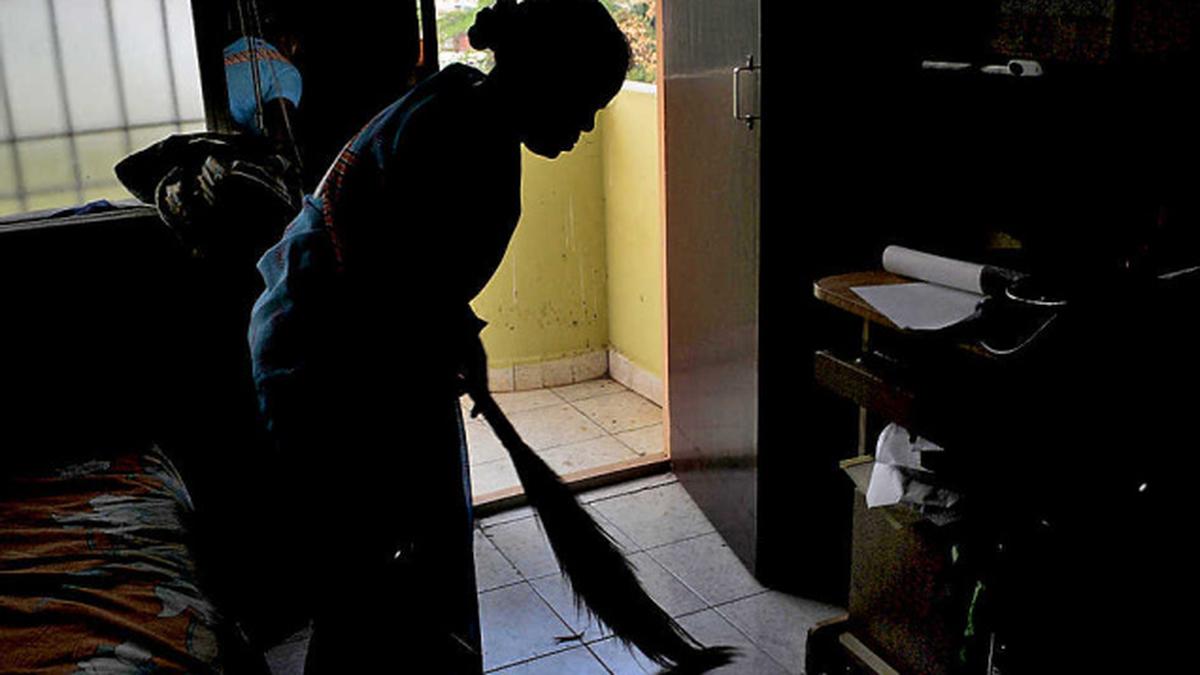

Picture for representation. File
| Photo Credit: The Hindu
In January, the Supreme Court directed the Union government to enact a comprehensive law to stipulate the rights of domestic workers and set up a committee to look into setting up a framework for it. The Court directed the committee to submit a report in six months. Whether this has been done or not remains unclear.
Status of domestic workers
India is estimated to have 4 million-90 million domestic workers. A majority of them are women and girls and most of them are from Scheduled Caste (SC) and Scheduled Tribe (ST) communities, rendering them particularly vulnerable to structural power differences.
The Court’s recent directive was issued as part of criminal proceedings involving the confinement and trafficking of a female domestic worker from a ST community from Chhattisgarh to Delhi. These proceedings bring attention to several considerations that are important in devising rights and protections for domestic workers. Workers toil in the homes and workspaces of other people, which has the effect of atomising them. Inspections into workplace conditions become nearly impossible. These workers may be subject to harassment, abuse, and segregationist practices. Child labour is rampant in this sphere. Exploitative employment agencies and brokers frequently mediate relationships between employers and employees. While some workers labour full time in a single household, others work across multiple households for a few hours each day. This can make the stipulation and enforcement of minimum wages, work hours, and leave entitlements tricky.
Many workers are migrant workers who need protections across State borders. Workers also routinely come in from neighbouring countries. The absence of a separate national-level legislation to look into protections and benefits hurts workers in multiple ways.
In recognition of their contributions to the global economy, the International Labour Organization passed a Convention (no. 189) in 2011 to ensure the rights and protections of domestic workers. While India voted in favour of the convention, it is yet to ratify it. As noted by the Court, there have been multiple attempts to pass legislation at the national level from the 1950s. The National Platform for Domestic Workers (NPDW) was formed in 2012 specifically to demand a comprehensive Central legislation for domestic workers. The NPDW drafted a Domestic Workers (Regulation of Work and Social Security) Bill in 2017, but this Bill was never enacted into law. While the Court’s new directive is welcome, the fact that the Court directed various ministries to constitute a committee comprising “subject experts” with no representatives of domestic workers is a matter of concern.
Gains made at the State level
In Tamil Nadu, where there are about 2 million domestic workers, a welfare board has been set up under the Tamil Nadu Manual Worker Act, 1982. Through it, registered workers receive benefits, including pensions, maternity benefits, educational assistance for children, and accident relief. However, a very small number of workers are actually registered. While minimum wage is stipulated at ₹37-39 per hour, workers tend to make much less. They are seen as “part-time” workers because they may not work full time in a single household. In response to a plea filed by a domestic worker in Dindigul, the Madurai Bench of the Madras High Court directed the State government to consider enacting a special legislation to protect domestic workers.
Meanwhile, the Karnataka government announced the introduction of the Domestic Workers (Social Security and Welfare) Bill, 2025, which looks to regulate the working conditions of domestic workers. It requires that employers compulsorily register domestic workers with the government and commence employment with a written contract that includes an agreement on wages and work hours. It entitles workers to minimum wages, overtime pay, and weekly holidays. Importantly, it requires employers to contribute 5% of wages to a welfare fund that will distribute welfare benefits to domestic workers.
What should be done
Tamil Nadu is one of only 12 States that stipulates minimum wages for domestic workers. These wages must be updated and increased, while all States must be required to stipulate minimum wages for domestic workers. In addition to the already-mentioned provisions in the NPDW draft Bill and the Karnataka legislation, the NPDW recommends that all employers, employment agencies, and workers be compulsorily registered with the State government. A workbook must be issued to each employer through a tripartite board constituting employers, employees, and the State. This must be maintained by each employer and employee and endorsed each month. Women workers have reported not being able to access local complaints committees set up at the district level under the Sexual Harassment of Women at Workplace (Prevention, Prohibition and Redressal) Act. These complaints committees must be set up at panchayat and urban local bodies.
Housing is another critical consideration for domestic workers. While workers in Tamil Nadu received some assistance during the pandemic-induced lockdowns in 2020 and 2021, several could not pay rent. Rather than intermittent relief in the event of a “crisis”, structural solutions are imperative to protect the women in this critical workforce.
R. Geetha, Advisor to the Unorganized Workers Federation; Priti Narayan, Assistant Professor in the Department of Geography at the University of British Columbia
Published – October 22, 2025 01:06 am IST