
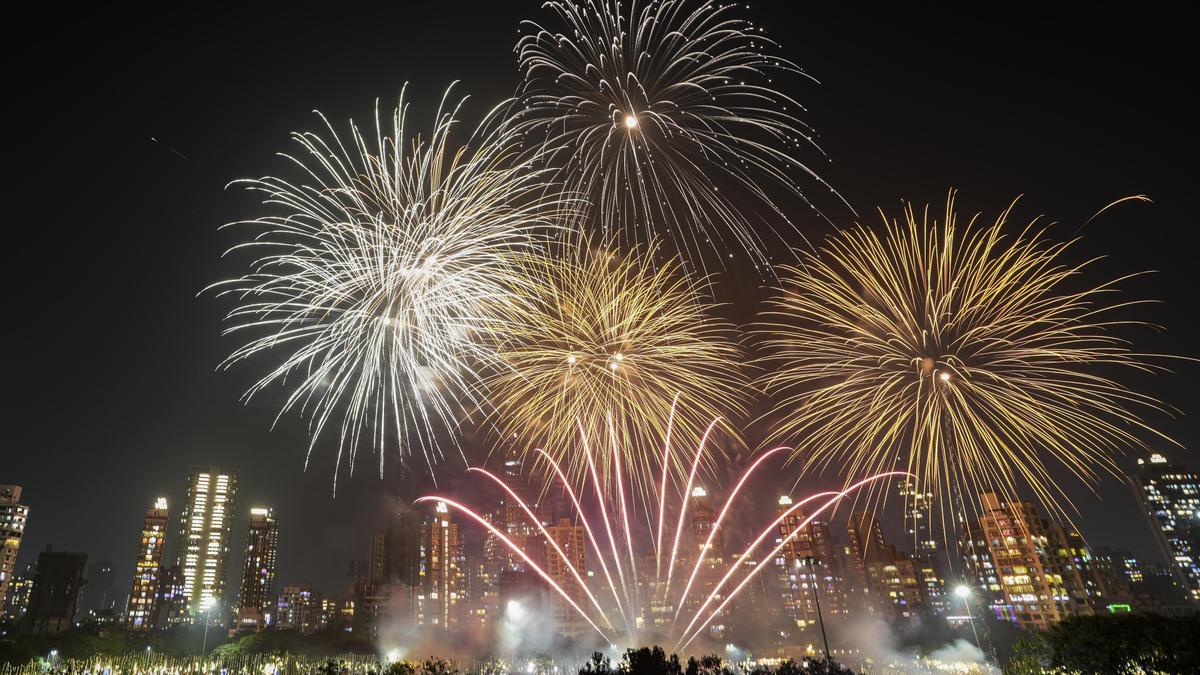
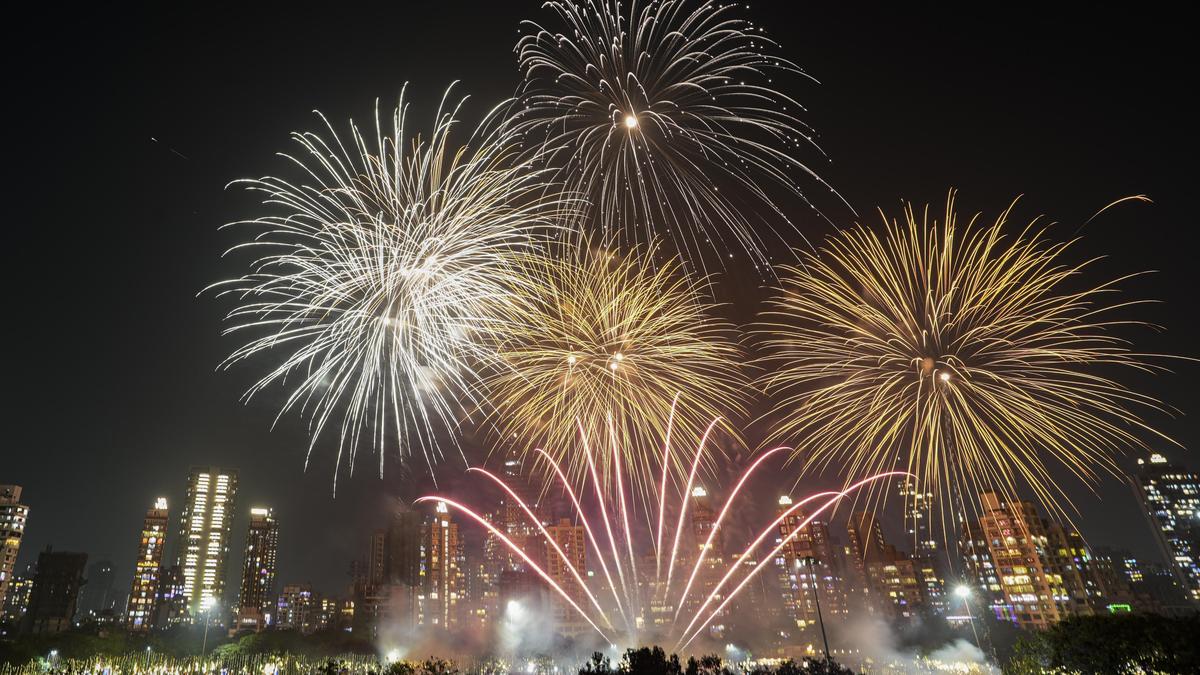
Fireworks explode during a celebration on the eve of the ‘Deepavali’ festival, at Chhatrapati Shivaji Park, in Mumbai, on October 19, 2025
| Photo Credit: PTI
Mumbai woke up on Tuesday (October 21, 2025) morning to a city shrouded in smog, the aftermath of Deepavali celebrations that saw widespread use of firecrackers. The air quality across the metropolis deteriorated sharply overnight, with several neighbourhoods recording AQI (Air Quality Index) levels in the ‘unhealthy’ and ‘severe’ categories. The city’s skyline was obscured by a thick layer of particulate matter that hung low and refused to disperse.
According to real-time data from AQI.in, Bandra Kurla Complex registered an AQI of 261, placing it in the ‘severe’ category. Babasaheb Ambedkar Nagar followed with a reading of 213, while Chakala in Andheri East recorded 194. Even residential zones such as Borivali West and Bhoiwada showed AQI levels of 188 and 191 respectively, indicating that the pollution was not confined to commercial hubs alone.

According to real-time monitoring by IQAir, the city-wide average AQI hovered around 174 on Tuesday morning, placing Mumbai in the ‘unhealthy’ category. PM2.5 concentrations stood at 89 µg/m³, nearly six times the World Health Organization’s recommended safe limit of 15 µg/m³. PM10 levels were also elevated at 132 µg/m³, contributing to the dense particulate matter suspended in the air.
The AQI is divided into six categories by the World Air Quality Index Project. An AQI between 0 and 50 is considered ‘good’, while 51 to 100 is ‘moderate’. Levels between 101 and 150 are ‘unhealthy for sensitive groups’, and 151 to 200 are ‘unhealthy’ for the general population. Readings between 201 and 300 fall into the ‘very unhealthy’ bracket, and anything above 301 is deemed ‘hazardous’, with serious health risks for all.
Experts attribute the spike in pollution to the extensive use of firecrackers during Deepavali, compounded by seasonal meteorological conditions. Low wind speeds, temperature inversion, and high humidity have trapped pollutants close to the ground, preventing their dispersion. The city’s Air Quality Early Warning System has flagged several zones for continued poor air quality, with forecasts indicating little relief in the coming days.

While Mumbai has seen periodic spikes in pollution over the years, the post-Deepavali surge has become an annual concern. Environmental activists, including Sumaira Abdulali of Awaaz Foundation, have long argued that without stricter regulation on firecracker sales and more sustainable urban planning, the city will continue to suffer from episodic air quality crises.
“The rains continued until just before Deepavali, so the contrast between clean air and the disruption caused by firecrackers is more stark than ever. You can draw a direct correlation; not only does the AQI worsen, but we’ve been conducting studies for many years that show what’s actually in the air during these spikes. The pollutants that contribute to the AQI are toxic and harmful to human health. This clearly shows why people should not be bursting crackers,” she explained.
According to health advisories issued by air quality monitoring platforms such as IQAir and AQI.in, residents are urged to avoid strenuous outdoor activities, particularly during early mornings and late evenings when pollution levels tend to peak. The use of N95 masks is recommended when stepping outdoors, and air purifiers are advised for indoor spaces. Individuals with respiratory or cardiac conditions are especially cautioned to monitor symptoms and limit exposure during periods of elevated pollution.
Published – October 21, 2025 01:46 pm IST